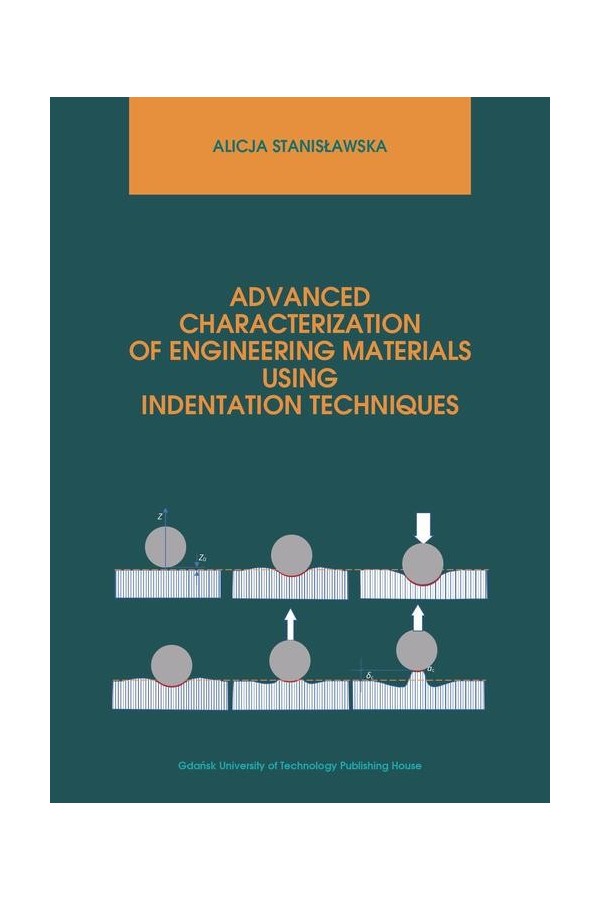
Publikacja jest dostępna na licencji Creative Commons CC BY-NC-SA 4.0 / The publication is available under the Creative Commons CC BY-NC-SA 4.0 license Over the centuries, the development of human civilization has been closely associated with the search for increasingly better materials that could win battles, enhance the quality of life, or enable the exploration of previously unknown regions. However, it is only since the beginning of the last century that we have observed rapid advancements in this area, driven by the production of new materials and the refinement of manufacturing techniques for existing ones. This rapid progress in new materials has also necessitated the development of research methods that allow for increasingly in-depth studies of the properties of newly developed, manufactured, and processed materials. A hundred years ago, tensile testing or hardness measurement sufficed to characterize the mechanical properties of materials. These methods are still in use today; however, the ever-increasing demands placed on new materials by designers have driven the need for novel research methods that enable more precise and detailed determination of their mechanical properties. Current requirements also extend to determining mechanical properties not only on a macro scale but also—due to the development of nanomaterials and techniques related to the deposition of thin layers and coatings—on a micro- and nanometric scale. It may seem that these issues pertain only to precision electronic systems, but even engineers designing much larger structures, such as bridges, want to know the properties of cement mortar in the zone adjacent to the aggregate, which spans an area several tens of micrometers wide, as the mechanical properties of this zone determine the mechanical properties of the entire concrete structure. Knowledge of the properties of materials used in various types of engineering constructions is essential for the proper selection of these materials by designers and technologists. One of the modern techniques for determining the mechanical properties of various groups of engineering materials is the indentation method, which involves pressing a diamond indenter into the material being tested. The method for determining the mechanical properties of materials based on the indentation test allows for the determination of many useful mechanical properties of materials belonging to various groups of engineering materials. It can be used to determine material properties on a macro-, micro-, and nanoscopic scale. For example, it allows for the determination of material hardness and stiffness (Young’s modulus), and in the case of brittle materials, such as ceramics or hard metals and alloys, it enables the determination of the critical stress intensity factor. Using this method, it is possible to determine not only the values of residual stresses of the first, second, and third types in metals and alloys but also their nature (sign). The indentation test also enables the study of creep rates in various materials and the determination of dislocation density in metallic materials and their mobility. These material properties can be investigated under both static and dynamic loading conditions. The theoretical foundations for the indentation test using a spherical indenter were first formulated by Heinrich Hertz at the end of the nineteenth century [1, 2], and in subsequent research, they were further developed for a conical indenter by the Scottish mathematician Ian Naismith Sneddon [3, 4].





![Połączenie acetaminofenu i ibuprofenu w leczeniu gorączki u dzieci [Medycyna Faktów 3/2022] - Lidia Rutkowska-Sak - Ebook](https://www.ebuczek.pl/90393-home_default/ebook-polaczenie-acetaminofenu-i-ibuprofenu-w-leczeniu-goraczki-u-dzieci-medycyna-faktow-3-2022-lidia-rutkowska-sak.jpg)